A father-and-son journey to the top of Europe
- August 15, 2026
- 0
Between the Summit and the Decision
A father-and-son journey to the top of Europe became a story about purpose, risk, faith and knowing what a summit is really worth.
Some mountains are remembered for the view from the top. Others are remembered for the decisions made along the way.
For Joe Abi Azar and his father, Georges, Mount Elbrus became both.
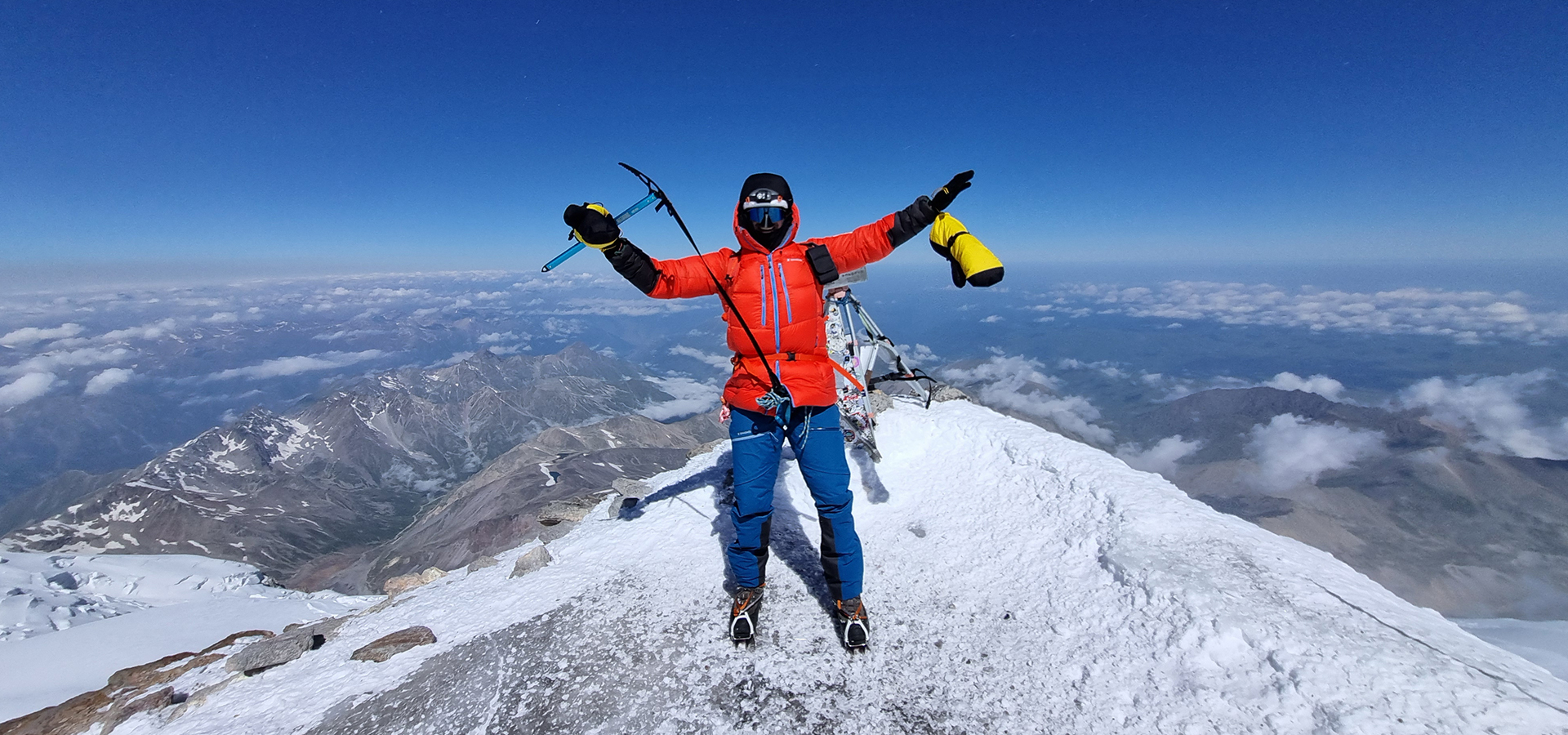
Travelling from Lebanon to the Caucasus, the pair set out to climb the 5,642-metre western summit of Mount Elbrus, the highest mountain in Europe. Yet their expedition carried a purpose beyond personal achievement: they were climbing in support of the Children’s Cancer Center of Lebanon (CCCL), hoping to carry its cause from Lebanon all the way to the roof of Europe.
For Joe, that purpose changed the meaning of the expedition.
“The summit mattered to us, but so did what we hoped the climb could represent.”
From Green Valleys to a White Mountain
Their nine-day expedition began far from the harsh image usually associated with Elbrus. The first days were spent acclimatizing through the green landscapes of the Caucasus: alpine forests, wildflowers, waterfalls and long mountain trails.
The contrast was striking. Meltwater poured from the snowfields above into rivers and waterfalls while the white mass of Elbrus towered over the landscape.
Life also became noticeably simpler. Accommodation was basic, with eight people sharing a room with bunk beds, while limited internet access and restrictions on familiar social-media platforms created an unexpected sense of isolation.
Their world temporarily narrowed to the essentials: walking, eating, checking equipment, watching the weather and recovering for the following day. But beneath the beauty of those first hikes was an increasingly serious reality.
Around the time of their arrival, reports of fatal accidents on Elbrus were circulating in the region. Five climbers from Bosnia and Herzegovina had died after encountering severe conditions, while other fatal incidents had occurred during the preceding weeks.
Suddenly, the mountain no longer felt like simply another objective on an itinerary.
Elbrus is sometimes described as one of the more “accessible” high-altitude mountains. Cable cars and snowcats reach high onto its southern slopes, and its normal route is not considered extremely technical. But accessibility should never be confused with safety.
At 5,642 metres, altitude, wind, extreme cold, exhaustion and rapidly changing visibility can transform a seemingly straightforward climb into a dangerous environment within minutes.
The Mountain Takes Over
By Day 4, Joe and Georges had left the greenery behind and moved to a mountain shelter at approximately 3,900 metres.
From that point onward, the expedition changed character completely.
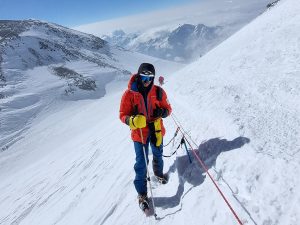
Snow and ice replaced forests and flowers. Temperatures dropped. Equipment that might have seemed excessive in the valley—crampons, ice axes, harnesses, goggles, down layers, balaclavas and heavy mittens—became essential.
Summit-night temperatures could approach -20°C. During an acclimatization climb toward 4,800–5,000 metres, another concern emerged. The third member of their small climbing group, Casper, a climber from Hong Kong with limited previous mountain experience, was visibly struggling with exhaustion.
With three climbers and only one guide, the situation presented a serious problem. If one climber needed to descend, splitting the group would be difficult. The team eventually decided to use a snowcat on summit day to begin the final climb from close to 5,000 metres, conserving energy for the upper mountain and, crucially, for the descent.
Then came the weather. Both available summit days carried poor forecasts, with winds expected to exceed 50 km/h. Friday appeared marginally better, with less cloud predicted around the summit. It was not a good weather window. It was simply the less dangerous of two poor options. Before leaving, the group made one important agreement: if one climber had to turn around, everyone would turn around. Hours later, that agreement would be tested.
Summit Night
At approximately 1 a.m., the climbers left in darkness. Headlamps illuminated the snow as crampons cut into the frozen surface. The wind was already strong. As conditions became more difficult, prayer became part of his rhythm on the mountain.
Then the problems began. Casper’s crampons repeatedly came loose from his boots. Each repair meant stopping in the wind and cold, consuming time, warmth and energy.
By approximately 5,300 metres, his condition had deteriorated significantly. Exhausted and breathing heavily, he collapsed onto the slope. The guide made the call: Casper needed oxygen. They had to descend. For Joe and Georges, it seemed their summit attempt was over. They had made an agreement, and they were prepared to respect it. Joe’s disappointment was immediate. After days of preparation and hours of climbing, the summit was relatively close—but the mountain had apparently made the decision for them.
Then the situation changed. The guide suggested that he could remain with Casper while Joe and Georges continued toward the summit alone. At the same time, he warned them that given the conditions, he was not convinced it was a good idea.
Joe’s first reaction was to turn around. “Baba, let’s not do it. It looks too dangerous.” His father initially agreed.
Then they were given another two minutes to decide. They were already at roughly 5,300 metres. Other climbers were still moving upward behind them. The summit was comparatively close. None of this meant that continuing was safe. It simply became part of the calculation.
Georges made the decision: father and son would continue.
For roughly the next two hours, Joe and Georges climbed without their guide through the most demanding section of their route. Fixed ropes, steep snow and ice, powerful winds and altitude now stood between them and the summit. Initially they tried to move quickly, hoping to recover the time they had lost. It almost emptied their remaining reserves. The summit was visible, yet their bodies struggled to cover the distance. Until eventually, there were no more steps upward to take.
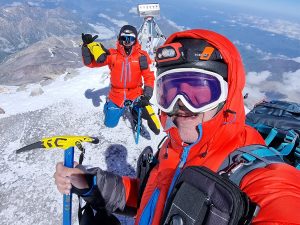
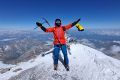
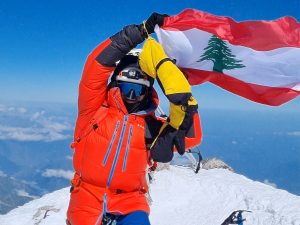
Joe and Georges had reached the 5,642-metre summit of Mount Elbrus. They stayed for barely ten minutes. The wind was so powerful that Georges struggled to hold his phone steady while Joe raised the flags they had carried from Lebanon. Among them was the flag of the Children’s Cancer Center of Lebanon.
For Joe, it was the moment when the physical achievement and the purpose behind the expedition finally became one. But celebration had to wait.They still had to come down.
The Summit Was Only Half the Story
Descending proved exhausting. The wind that had accompanied them upward was now blowing directly into their faces. Some gusts were strong enough to force them to crouch toward the snow and brace themselves before continuing.
Eventually, they saw their guide climbing back toward them. After helping Casper reach the saddle and stabilizing the situation, he had returned uphill to assist Joe and Georges.
His presence provided much-needed support through the difficult section. At the saddle, the three climbers were reunited.
By around noon they were back at camp, roughly ten to eleven hours after the summit operation had begun. The Decision That Outlived the Summit. Later, the guide said something to Georges that would become perhaps the most important line of the entire expedition.
He was happy they had reached the summit. But he still wasn’t certain that allowing them to continue alone had been the right decision.
That admission changed the way Joe looked at the achievement.
Mountaineering has an uncomfortable relationship with success. A dangerous decision followed by a safe return can easily be remembered as bravery. The same decision followed by tragedy may be remembered as recklessness.
The outcome does not necessarily prove that the decision was right.
Joe and Georges had experience, equipment and determination. But they also knew that they had accepted additional risk.
The wind could have strengthened. Visibility could have disappeared. Equipment could have failed. Altitude sickness, exhaustion or a single fall could have rewritten the ending completely. And reaching the summit did not erase any of those possibilities.
Coming Home With More Than a Summit
For Joe, Elbrus ultimately became as much a mental journey as a physical one. The cold and altitude were punishing, but the hardest questions were internal:
When does determination become stubbornness? When should ambition give way to caution?
And how do you make the right decision when months of preparation, emotion and a summit only a few hundred metres away are all influencing your judgment? Sometimes, as Joe discovered, the mountain gives you only two minutes to answer.
Today, his memories of Elbrus extend far beyond the summit photograph.
He remembers the green Caucasus valleys, the waterfalls, the bunk beds and the isolation. He remembers the reports of climbers who never returned home. He remembers Casper collapsing at 5,300 metres and the moment he told his father they should turn back.
Until father and son stood together on top of Europe, carrying a cause from Lebanon with them.
After the expedition, their guide told Joe that he believed he could become a strong climber. Joe’s thoughts immediately moved toward greater heights, perhaps even a future 7,000-metre peak.
His parents offered a different message: slow down, gain experience and don’t rush toward the next summit. After Elbrus, that advice carries a different weight. Because perhaps the greatest lesson Joe and Georges brought home from 5,642 metres was not about how to reach a summit. It was about understanding that mountains will always be there.
And that sometimes the most important achievement is not standing on top of one. It is coming back home.